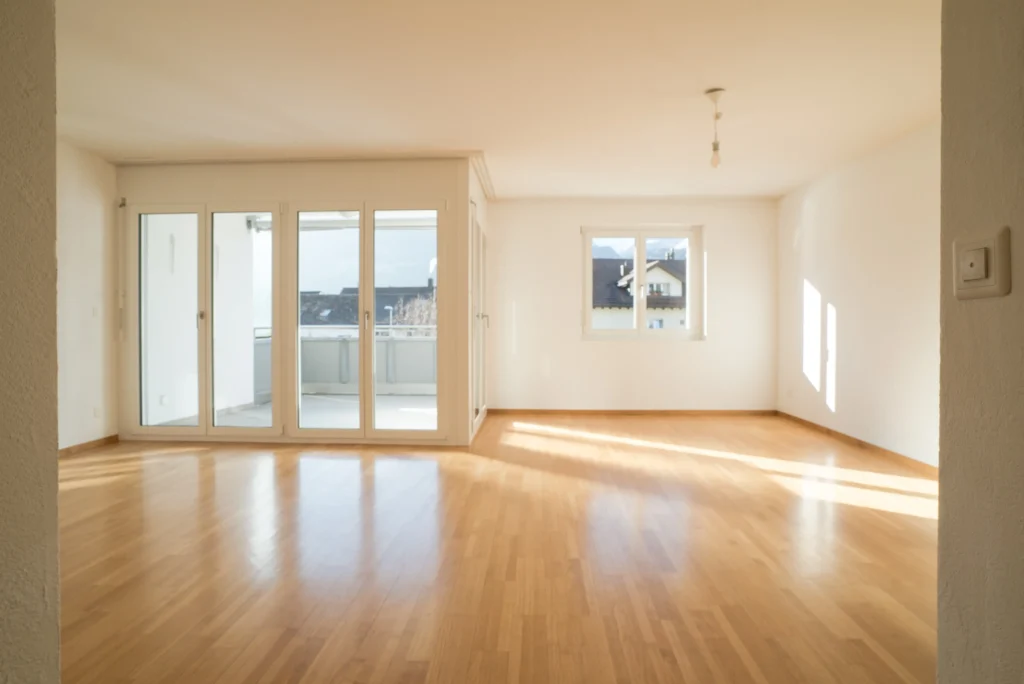
An empty house sounds like it should be easier to sell.
No tidying before a viewing.
No negotiating appointment times around family life.
No pets to relocate every time somebody wants to look around.
And no frantic dash around the kitchen five minutes before the estate agent arrives.
Sometimes it is easier.
But a vacant property also creates a different set of challenges.
Perhaps you’ve inherited a home.
Maybe you’ve relocated for work.
You’ve moved in with a partner.
You’ve bought your next property before selling.
Or an elderly relative has moved permanently into care.
Whatever the circumstances, selling an empty house requires a slightly different strategy from selling somewhere that’s still being lived in.
From insurance and security to photography, heating and presentation, here’s what we’d think about before putting a vacant property on the market.
Is an empty house harder to sell?
Not necessarily.
There are actually some advantages.
Viewings can be easier to arrange.
Buyers aren’t distracted by somebody else’s belongings.
Every room is accessible.
There’s no seller worrying about keeping the property immaculate every day.
And an empty property can make the logistics of completion relatively straightforward where there is no onward purchase.
But there are disadvantages too.
Without furniture, buyers can struggle to judge scale.
An empty house can feel colder and more echoey.
Small maintenance issues may go unnoticed because nobody is there every day.
And if the property looks obviously unoccupied, security becomes more important.
So we wouldn’t automatically describe an empty property as a problem.
We’d simply market and manage it differently.
Do empty rooms look smaller?
They can.
It sounds counterintuitive.
Surely removing furniture makes a room look bigger?
Sometimes it does.
But furniture also provides scale.
A buyer standing in an empty bedroom may struggle to work out whether their double bed, wardrobes and chest of drawers will fit comfortably.
Put a bed in the same space and the answer becomes immediately obvious.
This is particularly relevant online.
Property photographs are usually the buyer’s first meaningful experience of a home, and a series of empty white rooms can make it harder to understand how the accommodation actually works.
That’s where good photography, accurate floor plans and thoughtful presentation become particularly important.
Should you stage an empty house before selling it?
Sometimes.
But we wouldn’t automatically tell every seller to furnish an entire empty property.
First ask:
What problem are we trying to solve?
If buyers are struggling to understand the size of the principal bedroom, dressing that room could help.
If the sitting room has an unusual layout and buyers can’t visualise where the furniture would go, some staging may make sense.
If the property already has strong proportions, distinctive features and excellent photography, spending thousands furnishing it may add very little.
There’s also a middle ground.
A small amount of carefully chosen furniture or styling in the rooms where scale matters most may be enough.
The decision should come from the property and buyer feedback rather than the assumption that every vacant home needs dressing.
What about virtual staging?
Virtual staging can help buyers visualise how an empty room could be used, particularly in online marketing.
But transparency matters.
If digitally added furniture or other alterations are used, buyers shouldn’t be misled into believing they’re looking at something physically present in the property.
Used properly, virtual staging can be a visualisation tool.
It shouldn’t become a way of disguising condition, changing dimensions or digitally creating features the property doesn’t have.
At Location Location East, we’d decide whether physical staging, virtual presentation or simply excellent photography gives the clearest and most effective representation of the individual home.
Do you need special insurance for an empty house?
This is one of the first things we’d tell a seller to investigate.
Don’t assume your existing home-insurance policy continues unchanged once nobody is living at the property.
Insurers have different definitions of an “unoccupied” home and different restrictions, conditions and time limits.
Some standard policies reduce or restrict elements of cover after a property has been unoccupied for a specified period. The period varies by insurer and policy, so there isn’t one universal 30-day or 60-day rule.
You may be required to tell the insurer that the property is empty.
They may impose additional conditions.
Those could include regular inspections, maintaining a minimum temperature, turning off or draining water systems, securing the property in a particular way or arranging specialist unoccupied-property cover.
Contact your insurer as soon as you know the property will be vacant and follow the requirements of your particular policy.
Don’t wait until you need to make a claim to discover that the circumstances should have been disclosed.
How often should an empty property be checked?
Again, start with your insurance policy.
It may specify how frequently the property must be inspected and what records should be kept.
Even where there isn’t a particular insurance requirement, regular checks are sensible.
A small leak in an occupied home is often spotted quickly.
In an empty house, it could continue for days.
The same applies to storm damage, a failed boiler, a broken window or signs that somebody has attempted to enter.
Keep a record of visits if required by the insurer, including dates and any action taken.
For sellers who no longer live locally, having trusted people nearby becomes particularly important.
Should you leave the heating on in an empty house?
Don’t apply a blanket rule without checking the property and insurance requirements.
During colder weather, maintaining an appropriate background temperature can help reduce the risk of frozen pipes and make the property considerably more comfortable for viewings.
But some insurers may have specific winter requirements relating to heating, water supplies or draining systems.
Follow your insurer’s requirements and obtain appropriate heating or plumbing advice if you’re unsure.
From a marketing perspective, however, there is a very simple point:
a freezing house isn’t pleasant to view.
Buyers shouldn’t need to keep their coat zipped to the chin while trying to imagine living there.
How do you keep an empty house looking cared for?
The exterior matters just as much as the rooms.
An overflowing letterbox, bins that haven’t moved, long grass or piles of leaves can quickly make a property look neglected.
Try to keep on top of:
- post and leaflets
- lawns and planting
- fallen leaves
- bins
- windows
- obvious exterior maintenance
- cobwebs and dust inside
- stale air
- heating during colder weather where appropriate
- lighting for late-afternoon or evening viewings
The objective isn’t to pretend somebody still lives there.
It’s to make it obvious that somebody is still looking after it.
Should you put lights on timers in an empty house?
Possibly, but think about security as a whole rather than relying on one trick.
Timers or smart lighting can help a property appear less obviously vacant after dark.
You should also consider whether doors and windows are properly secured, who holds keys and whether any alarm or security system needs maintaining.
Don’t advertise unnecessarily that the property is empty.
That includes being careful about what is posted publicly on social media.
For individual security and insurance requirements, follow the advice of your insurer and appropriate security professionals.
Who should hold the keys to an empty property?
Know exactly who has them.
Vacant homes can accumulate keys surprisingly easily.
Family members.
Neighbours.
Tradespeople.
Cleaners.
The previous occupier.
Your solicitor.
Your estate agent.
If you’ve inherited a property and don’t know how many keys exist, changing the external locks may be worth considering.
At the very least, carry out a simple key audit.
Know who can access the property and recover keys that are no longer required.
Should you clear everything out before selling an inherited property?
Usually you’ll want the property cleared appropriately before marketing, but don’t rush into disposing of everything without thinking.
With an inherited property, there may be personal possessions that family members need to deal with.
There may also be paperwork relating to the property hidden amongst ordinary household documents.
Certificates.
Guarantees.
Planning paperwork.
Building Regulation approvals.
Invoices for improvements.
Boiler records.
Window documentation.
Property deeds or historic information.
Before a clearance company arrives, go through documents carefully and speak to the appropriate solicitor or executor where necessary.
Can you market a probate property before probate is granted?
In many circumstances, a property can be marketed before the Grant of Probate has been issued.
However, the legal position and timing of the sale need to be managed carefully.
The executors generally cannot complete the sale until the necessary authority is in place, and buyers should be given realistic information about potential timescales.
That’s one reason communication between the estate agent and probate solicitor is particularly important.
At Location Location East, we regularly advise people selling inherited or probate property from a sales and marketing perspective, while the solicitor deals with the legal administration of the estate.
What paperwork should you find before selling an empty property?
Use the opportunity to get organised.
Depending on the property, useful documents may include:
- Energy Performance Certificate
- boiler and heating records
- electrical documentation
- window and door certificates
- planning permissions
- Building Regulations approvals
- guarantees and warranties
- paperwork for extensions or alterations
- information relating to boundaries
- details of services or private drainage where relevant
- leasehold or estate-management information where applicable
Your conveyancer will tell you what is required for the transaction.
Getting started early can prevent avoidable delays later.
How should you price an empty house?
Exactly as we’d price an occupied one:
using current market evidence and a strategy designed to attract the right buyers.
Vacancy itself doesn’t automatically mean the property is worth less.
But an empty property does have carrying costs.
Depending on the circumstances, these might include:
- mortgage payments
- insurance
- Council Tax
- utilities
- gardening
- security
- maintenance
- regular inspections
So it’s worth understanding what another month of ownership actually costs.
That doesn’t mean accepting the first low offer because the house is empty.
Nor does it mean buyers should assume an executor, landlord or relocated owner is desperate to sell.
It simply means the seller should understand the complete financial picture when making decisions about price and offers.
Do you still pay Council Tax on an empty property?
Potentially, yes.
Council Tax rules for empty properties depend on the circumstances and the relevant local authority.
Councils can decide whether to offer discounts for certain empty homes, while properties left empty for extended periods can attract an empty homes premium.
There are also exemptions in particular circumstances.
Probate is a good example.
Government guidance says a property can be exempt from Council Tax if it is empty because the person who lived there has died and probate or letters of administration have not yet been granted. After the grant, a further exemption of up to six months may apply provided the property remains unoccupied and still belongs to the estate.
Check the position with the relevant council rather than assuming no Council Tax is due simply because nobody lives there.
What if you’re selling an empty property from a distance?
This is where your choice of estate agent becomes particularly important.
If you’ve moved to another part of the country, or you’re an executor dealing with an inherited home from several hours away, you can’t realistically drive over every time there’s a viewing or somebody needs access.
An agent with a strong local presence can help coordinate the sales side of that process.
At Location Location East, accompanied viewings are an important part of our service.
We can manage buyer access, provide feedback, communicate with you remotely and keep an eye on the property during our visits.
Where contractors, insurers, solicitors or other professionals need to be involved, we’ll communicate with the relevant people as appropriate while remaining clear about the limits of our role.
You’re still the property owner or executor.
But you shouldn’t need to be standing outside the front door every time a potential buyer wants to see the house.
Is an empty house a sign that a seller will accept a low offer?
No.
Buyers may sometimes assume that an empty property means the owner is under pressure to sell.
That assumption can produce speculative offers.
Our job as the seller’s estate agent is to negotiate using the actual position.
How much interest has there been?
Are other buyers considering the property?
What have comparable homes sold for?
How strong is the buyer’s position?
What are the seller’s priorities?
A vacant property shouldn’t automatically be treated as a distressed sale.
And we wouldn’t market it as one unless there were very specific circumstances requiring that approach.
Selling an empty home in Thetford or across the Brecks?
Empty properties often arise from circumstances that need a little more care than an ordinary move.
You may be dealing with bereavement.
You might have relocated hundreds of miles away.
An elderly relative may have moved into care.
Perhaps you’ve already bought somewhere else and simply want the previous house dealt with properly.
At Location Location East, we adapt the sales strategy to the situation rather than treating every property the same way.
Our core market is around Thetford and the Brecks, with our estate agency work extending across Norfolk and Suffolk.
For a vacant property, that means thinking carefully about presentation, buyer targeting, accompanied viewings, feedback, negotiation and sales progression.
And if you’re managing the sale from somewhere else, communication becomes even more important.
An empty home doesn’t need to feel abandoned.
It needs a plan.
Frequently Asked Questions
Is it harder to sell an empty house?
Not necessarily. Empty homes can be easier to access for viewings and allow buyers to see every part of the property clearly. However, furniture can help establish scale and atmosphere, while vacant properties also require more attention to insurance, security and maintenance.
Do empty houses sell for less?
There isn’t a rule that an empty property is worth less simply because nobody lives there. Value should be assessed using the property, location, condition, comparable evidence and buyer demand. Buyers may sometimes make lower offers if they believe a vacant seller is motivated, but that doesn’t determine the property’s market value.
Do I need to tell my home insurer that my property is empty?
Check your policy and speak to your insurer. Many policies have specific definitions, restrictions or conditions relating to unoccupied homes, and the permitted period varies. Don’t assume your existing cover continues unchanged.
Should I leave the heating on in an empty house during winter?
Check your insurance requirements first. Depending on the property and policy, maintaining an appropriate background temperature may help protect plumbing and make winter viewings more comfortable. Some policies have specific requirements regarding heating or water systems during periods of vacancy.
Should I stage an empty house before selling?
Not always. Staging can help buyers understand scale and room use, particularly in key living spaces and bedrooms. But good photography and a clear floor plan may be sufficient for some properties. Decide based on the individual home and the problem you’re trying to solve.
Can virtual furniture be added to property photographs?
Virtual staging can help demonstrate how an empty space might be used, but marketing must not mislead buyers. Digitally added furniture or alterations should be used transparently and shouldn’t disguise defects or create physical features that don’t exist.
Can you sell a house while waiting for probate?
A probate property can often be marketed and a buyer found before the Grant of Probate is issued, but completion will normally depend on the executors having the necessary legal authority. Speak to the probate solicitor about the particular estate and likely timescales.
Do you pay Council Tax on an empty probate property?
An empty property can qualify for a Council Tax exemption where its former occupier has died and probate or letters of administration haven’t yet been granted. Following the grant, a further exemption of up to six months may apply while qualifying conditions continue. Check the circumstances with the relevant local authority.
Can Location Location East sell an empty property if I live elsewhere?
Yes. Location Location East can handle the estate-agency side of a vacant property sale, including marketing, accompanied viewings, buyer feedback, negotiation and sales progression. We can communicate remotely if you don’t live locally.
Does Location Location East sell probate and inherited properties?
Yes. We can provide the property appraisal, marketing and estate-agency service for inherited and probate property sales. Probate and estate administration remain matters for the executors and their legal advisers, so we work alongside the appropriate professionals rather than providing legal advice.
Sources
GOV.UK, Council Tax: second homes and empty properties, including Council Tax treatment where a property is empty following the death of its owner or occupier.
Association of British Insurers, consumer guidance on home insurance, including the importance of informing an insurer about changes in circumstances and checking policy conditions relating to an unoccupied property.
This article provides general information only and does not constitute legal, insurance or tax advice. Insurance policies and individual circumstances differ, so speak to your insurer and appropriate professional advisers about your particular property.
Article by Andrew Overman | Partner | Location Location East