
After weeks of speculation, the Autumn Budget has finally arrived.
And this time, there are some significant announcements for people buying their first home, landlords receiving rental income and households concerned about rising energy costs.
There’s a new first-time buyer scheme, changes to the Lifetime ISA, higher taxes on rental income and additional funding for affordable housing.
But not everything takes effect immediately.
Some measures begin tomorrow. Others arrive in 2027, while the new First Time Buyer ISA won’t launch until 2029.
And one widely reported change, the removal of gas standing charges, still requires action from Ofgem.
So what was actually announced on Wednesday 28 October 2026, and what does it mean for people living, buying and selling property around Thetford, the Brecks and wider Norfolk and Suffolk?
Here’s what you need to know.
What are the main property announcements in the Autumn Budget 2026?
The five developments most relevant to homeowners, buyers and landlords are:
- First-time buyers: A new government equity-loan scheme and a replacement for the Lifetime ISA.
- Landlords: Higher income tax rates on rental income from April 2027.
- Energy bills: A £100 Household Energy Payment and an extension of the temporary electricity VAT cut.
- Gas standing charges: A proposal to remove them and recover the costs through gas unit rates instead.
- Housing supply: An additional £1.5 billion intended to support around 10,000 social and affordable homes.
There were also other housing-related measures, including changes affecting social housing and certain property taxes.
Importantly, there was no general change to the standard residential Stamp Duty Land Tax bands.
That will be welcome clarity for buyers and sellers who have spent recent weeks reading speculation about potential changes.
Is the Lifetime ISA being scrapped?
The government has announced that the Lifetime ISA will be replaced for new savers by a First Time Buyer ISA from April 2029.
Existing Lifetime ISA holders will be able to continue contributing to and using their accounts under the existing arrangements.
The replacement product will allow eligible savers to contribute up to £4,000 a year and receive a 25% government bonus, paid when funds are withdrawn for a qualifying first-home purchase.
The government has confirmed that the new ISA will retain a £450,000 maximum property purchase price, with a maximum bonus of £20,000 and no upper age restriction.
So this isn’t the immediate abolition of existing Lifetime ISA accounts.
And if you’re already saving into one, don’t rush to move your money because of today’s announcement.
What’s changing with the Lifetime ISA withdrawal penalty?
From 29 October 2026, the withdrawal charge for existing Lifetime ISA holders buying a qualifying first home above the £450,000 property price cap will reduce from 25% to 20%.
This is a targeted change.
It does not mean every Lifetime ISA withdrawal will now attract a 20% charge.
The standard 25% charge remains for other unauthorised withdrawals.
The distinction matters because the existing 25% withdrawal charge can take away more than the government bonus.
For example, if you’ve contributed £4,000 and received a £1,000 government bonus, your account contains £5,000 before investment growth or losses.
A 25% withdrawal charge would leave £3,750.
A 20% charge would leave £4,000.
The new treatment therefore protects the original contribution in that simplified example for qualifying purchases above the property price cap.
For buyers in our local market, where many first homes fall below £450,000, this particular change may not affect their plans.
But it could be important for savers buying in more expensive areas.
What is the new Your First Home scheme?
This could be one of the more significant announcements for first-time buyers.
The government has confirmed £4.7 billion for Your First Home, an equity-loan scheme intended to help around 70,000 first-time buyer households in England.
The main features announced are:
- A minimum buyer deposit of 2.5%.
- A government equity loan of up to 20%.
- A five-year interest-free period on the equity loan.
- Household income caps of £110,000 outside London and £140,000 in London.
- Local property price caps.
- A scheme focused on eligible new-build homes through participating developers.
Pre-registration is expected by the end of December 2026, with full applications from February 2027 and the first loans from April 2027.
The detailed rules and eligibility arrangements will matter enormously.
How could Your First Home help buyers in Thetford?
Imagine you’ve found a suitable new-build home but saving a larger deposit has been the biggest obstacle.
A lower minimum deposit, combined with an equity loan, could potentially make purchasing more accessible.
But there’s an important distinction between having enough deposit and being able to afford the home.
A government equity loan isn’t free money.
It is a financial commitment with its own terms, and the initial interest-free period doesn’t remove the longer-term cost or repayment obligations.
Buyers will still need to consider mortgage affordability, future payments, household expenditure and the equity-loan conditions.
There are also local property price caps, so eligibility won’t simply depend on being a first-time buyer.
For somebody considering a new-build home around Thetford, Brandon or elsewhere in the area, this is worth investigating as the scheme opens.
For somebody hoping to buy an older terrace, bungalow or established family home, it won’t replace the normal mortgage and deposit route.
Our advice would be to explore the scheme, but not put your entire moving plan on hold until you’ve established whether you qualify.
Has the £20,000 Cash ISA allowance changed?
No.
The government has decided to retain the annual Cash ISA subscription limit at £20,000 rather than proceed with the previously planned reduction.
That’s relevant to people saving towards a deposit who want to keep their savings within a tax-efficient account.
However, the Cash ISA and the new First Time Buyer ISA are different products with different purposes and rules.
Anyone deciding how to save for a property should consider the withdrawal restrictions, tax treatment and suitability of the account for their circumstances.
What does the Autumn Budget mean for landlords?
For landlords, the most immediate longer-term financial announcement is the increase in income tax rates applied to property income.
From 6 April 2027, the new rates will be:
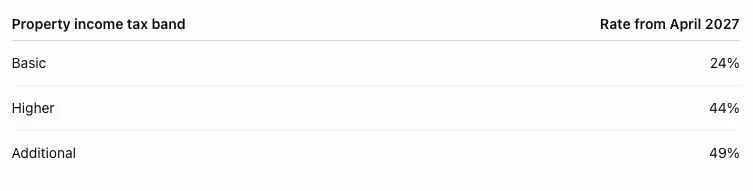
These are two percentage points above the corresponding previously planned property income tax rates.
The new rates will apply in England, Wales and Northern Ireland.
This doesn’t mean every landlord automatically pays 24%, 44% or 49% on their gross rental income.
Tax depends on individual circumstances, the calculation of taxable property income, allowable deductions and the wider tax position.
But it does mean landlords should review their expected returns.
Should landlords sell because rental income tax is increasing?
Not automatically.
A tax increase is relevant to investment performance, but it shouldn’t be considered in isolation.
For landlords in Thetford and the surrounding area, we’d suggest reviewing the whole picture.
What is the property worth today?
What rent does it generate?
What are the mortgage and running costs?
Is significant maintenance approaching?
What is the EPC position?
What future investment might be required?
How does the likely net return compare with the alternatives?
And perhaps most importantly, do you still want to own and manage a rental investment?
The new rates take effect in April 2027, giving landlords time to discuss the implications with an accountant or tax adviser.
At Location Location East, we don’t provide lettings or property management.
However, we can provide a sales appraisal for landlords considering whether retaining or selling a property makes sense.
The Budget might be a reason to review your investment. It isn’t, by itself, a reason to rush into selling it.
Will households receive £100 towards their energy bills?
The government has announced a £100 Household Energy Payment for households in Council Tax bands A to D in England.
The payment is due from January 2027 and is expected to reach up to 20 million households.
It will be delivered through local authorities using the Council Tax system.
The Budget also provides £100 million in additional funding for local authorities to support households particularly affected by rising energy costs.
For households in Thetford, the relevant local authority is Breckland Council, while arrangements elsewhere will depend on the appropriate council.
Further practical delivery information should be checked as the scheme approaches.
And a word of caution.
Whenever financial support is announced, scam messages can follow.
Don’t provide banking details or personal information in response to an unsolicited message claiming you need to register urgently for the payment.
Use official council or government channels to check the arrangements.
Is electricity becoming cheaper?
The temporary 0% VAT rate on qualifying domestic electricity, introduced on 1 October 2026, has been extended until 1 July 2027.
The government estimates that the extension will reduce the annual Ofgem price cap in April 2027 by around £50.
That doesn’t mean every household will receive an identical £50 saving.
Actual bills depend on energy consumption, tariffs and future energy prices.
But the extension is intended to reduce some of the pressure households are facing.
Are gas standing charges being abolished?
Not yet.
The government has asked Ofgem to abolish domestic gas standing charges in Great Britain, with an ambition to deliver the change by the end of 2027 or as soon as possible afterwards.
But this isn’t simply a case of removing a cost from everyone’s bill.
The proposal is for suppliers to recover the relevant costs through gas unit rates instead.
That distinction is important.
A household using relatively little gas may benefit from no longer paying a separate fixed daily charge.
A household using considerably more gas could face a different outcome if unit rates increase.
The government has acknowledged that some households may be less able to benefit and says targeted mitigation will be developed.
Until the final arrangements are confirmed, nobody should assume the change guarantees lower bills for their particular home.
Why do energy costs matter to the property market?
Because buyers increasingly need to understand the full cost of owning a home.
A mortgage payment is only part of the monthly commitment.
Council Tax, electricity, gas, insurance, maintenance and other running costs all matter.
Two similarly priced homes can have very different running costs depending on their size, insulation, heating system and condition.
For sellers, that makes accurate information about energy performance and improvements useful.
For buyers, it reinforces the importance of looking beyond the asking price.
And for landlords, future running costs and energy-efficiency requirements remain relevant when deciding whether to improve, retain or sell an investment.
Is the government building more affordable housing?
The Budget provides an additional £1.5 billion for social and affordable housing, intended to support delivery of around 10,000 homes in England.
Funding will be prioritised towards Social Rent, particularly council housing.
The government says this brings total investment in the Social and Affordable Homes Programme to more than £40 billion over ten years.
There are also measures concerning borrowing for council housebuilding and VAT relief for land sold to qualifying social housing providers.
This is a national programme.
It doesn’t mean 10,000 homes will suddenly become available, nor does it tell us how many will be built locally.
That depends on planning, land availability, delivery programmes and investment decisions.
For our area, the important question will be how national funding translates into actual housing delivery across Breckland and neighbouring parts of Norfolk and Suffolk.
Has Stamp Duty changed in the Autumn Budget?
There has been no general change to the standard residential Stamp Duty Land Tax rates or first-time buyer thresholds.
That’s the key point for most people buying or selling a home.
However, the Budget does contain targeted SDLT measures, including technical changes affecting group relief, certain pension-scheme transactions and rent under assured tenancies.
So it would be inaccurate to say there were no stamp duty announcements at all.
For ordinary residential buyers, the existing purchase-tax framework remains the starting point.
Will the Autumn Budget affect house prices in Thetford?
It’s too early to draw that conclusion.
The Budget contains measures that could influence affordability, investment decisions and housing supply.
But house prices are affected by far more than one government announcement.
Mortgage rates.
Buyer confidence.
Employment.
Available properties.
Local demand.
The condition and location of individual homes.
And the price sellers are asking relative to what buyers are prepared to pay.
A new first-time buyer scheme could help some eligible purchasers.
Higher rental income tax could cause some landlords to reconsider their investments.
Energy support may help household budgets.
But translating those developments into a specific forecast for house prices in Thetford would be speculation.
Local market evidence remains more useful than a dramatic national prediction.
Should you wait until after the Budget to sell your home?
Well, the waiting is over.
And that’s worth remembering.
In the run-up to today’s announcement, there was considerable speculation about potential property taxes and changes affecting buyers and sellers.
Some of those ideas haven’t materialised as general changes to residential property transactions.
So if you’ve delayed making a decision specifically because you wanted to know what the Chancellor would announce, you now have considerably more information.
The next question is whether anything announced actually changes your circumstances.
If you’re selling an ordinary residential home, there isn’t an obvious new general transaction tax requiring you to change your plans.
If you’re a landlord, the rental income tax changes deserve consideration.
If you’re a first-time buyer, the new support schemes may be relevant depending on the type of property you want and your eligibility.
But for most homeowners, the decision to move still comes back to familiar questions.
Why are you moving?
What is your property realistically worth?
What can you afford next?
And does moving now suit your circumstances?
What should you do following the Autumn Budget?
If you’re buying your first home, investigate the new schemes, but don’t assume they apply to every property or buyer. Get appropriate mortgage advice before making financial commitments.
If you’re already saving in a Lifetime ISA, check the new rules carefully before withdrawing funds or changing accounts.
If you’re a landlord, arrange to review the April 2027 property income tax changes with your accountant. Consider your overall investment return rather than responding to the headline alone.
If you’re worried about energy bills, check your Council Tax band, watch for official guidance on the Household Energy Payment and remain cautious about unsolicited messages.
If you’re thinking of selling, concentrate on your property’s current market position and your reasons for moving, rather than assuming the Budget has changed the value of every home.
What does the Budget mean for Location Location East’s local property market?
For us, the most important thing is helping people separate what has actually changed from what they’re being told might happen.
We work with buyers, sellers and homeowners across Thetford, the Brecks and wider Norfolk and Suffolk.
Some will be saving for their first home.
Some will be considering a move after years in the same property.
Others will be landlords reassessing whether property remains the right investment.
Their circumstances are different.
So their response to the Budget should be different too.
At Location Location East, our role is to provide clear, evidence-led property advice, including realistic valuations, thoughtful marketing strategies and practical guidance throughout the selling process.
We can’t tell you what future government policy will be.
And we won’t pretend that one Budget announcement determines what your home is worth.
But we can help you understand the property market as it stands today.
Sometimes that means preparing to move.
Sometimes it means changing your plans.
And sometimes the most useful advice is that nothing announced today requires you to do anything differently.
Frequently Asked Questions
What did the Autumn Budget 2026 change for homeowners?
The main household and property measures include a new first-time buyer equity-loan scheme, changes to the Lifetime ISA, higher tax rates on property income from April 2027, energy-bill support and additional affordable housing investment. Standard residential Stamp Duty Land Tax bands were not generally changed.
When does the new First Time Buyer ISA start?
The government has announced an April 2029 launch. The new product will replace the Lifetime ISA for new savers, with existing Lifetime ISA holders able to continue using their accounts under the existing arrangements.
Has the Lifetime ISA withdrawal penalty been reduced?
From 29 October 2026, the charge falls to 20% for qualifying first-home purchases above the £450,000 property price cap. Other unauthorised withdrawals remain subject to the usual 25% charge.
When does the Your First Home scheme start?
The government expects pre-registration by the end of December 2026, applications from February 2027 and the first loans from April 2027. Eligibility and the detailed scheme conditions should be checked before making a decision.
Can I use Your First Home to buy an older house?
The scheme is intended for eligible new-build properties through participating developers. Buyers considering an established or older home will need to explore other financing options.
How much will landlords pay in property income tax from April 2027?
The announced property income tax rates are 24% at the basic rate, 44% at the higher rate and 49% at the additional rate. Individual tax liabilities depend on personal circumstances and the applicable rules.
Will I receive the £100 Household Energy Payment?
The announced payment is for households in Council Tax bands A to D in England from January 2027, with delivery through the Council Tax system. Check official government and local council guidance for practical arrangements.
Are gas standing charges definitely being removed?
Not yet. The government has asked Ofgem to abolish domestic gas standing charges, aiming for the end of 2027 or as soon as possible afterwards. The relevant costs would instead be recovered through gas unit rates, with further details and protections still to be developed.
Did Stamp Duty change in the October 2026 Budget?
There was no general change to the standard residential purchase-tax bands or first-time buyer thresholds. The Budget did include certain targeted and technical SDLT measures.
Should I delay selling my house because of the Autumn Budget?
Not automatically. The decision should depend on your reasons for moving, local market conditions, your property’s likely value and whether any announced measures materially affect your circumstances.
Can Location Location East advise on how the Budget affects my property?
We can discuss the local sales market, provide a property appraisal and help you assess your options if you’re considering buying or selling. For mortgage, tax, legal or investment decisions, you should seek advice from an appropriately qualified professional.
Sources
- HM Treasury, Budget 2026, 28 October 2026.
- HM Treasury, Budget 2026: Breathing space for today, hope for the future, 28 October 2026.
- HM Treasury, Budget 2026 Fact Sheet: Delivering for Every Region, 28 October 2026.
- GOV.UK, government announcements and guidance on the Your First Home scheme.
- GOV.UK, official Lifetime ISA and First Time Buyer ISA policy announcements.
Information correct to 28 October 2026. Some measures remain subject to legislation, implementation guidance or decisions by regulators. This article is for general information and does not constitute mortgage, legal, tax or financial advice. Always check the latest official guidance and seek appropriate professional advice before making financial decisions.
Article by Andrew Overman | Partner | Location Location East