The Bank of England has raised interest rates again.
On Thursday 5 November 2026, Bank Rate increased from 3.75% to 4%, the first rise since August 2023.
It’s the sort of headline that understandably makes homeowners, buyers and sellers a little nervous.
Will my mortgage payments increase?
Can I still afford to move?
Will buyers put their plans on hold?
And does this mean more interest rate rises are coming?
Before making any decisions, there’s one important thing to understand.
If you’re on a fixed-rate mortgage, yesterday’s announcement doesn’t automatically change your monthly payment.
And with most existing homeowner mortgage balances currently on fixed rates, that’s an important distinction.
So, what has actually changed, and what should you do about it?
What did the Bank of England announce?
The Bank of England’s Monetary Policy Committee voted by eight to one to increase Bank Rate by 0.25 percentage points, taking it to 4%.
The remaining committee member preferred a larger increase to 4.25%.
Bank Rate is the interest rate the Bank of England pays on reserves held by commercial banks.
It influences borrowing and savings rates across the economy, including mortgages.
But Bank Rate and mortgage rates aren’t the same thing.
Your mortgage rate depends on your lender, the product you’ve chosen and your individual circumstances.
And the effect of yesterday’s announcement depends largely on the type of mortgage you have.
It’s also worth putting the figure into perspective.
Bank Rate was at 4% during part of 2025, so yesterday’s decision takes us back to a level we’ve experienced relatively recently.
Why has the Bank of England raised interest rates?
The main concern is inflation.
The Bank of England aims to keep inflation at 2%.
However, UK Consumer Prices Index inflation reached 3.5% in September 2026.
Higher global energy prices have increased costs for households and businesses, and the Bank is concerned that those pressures could spread more widely through the economy.
Its latest forecast suggests inflation could reach around 5% by the middle of 2027 before easing.
Increasing Bank Rate is one of the tools the Bank uses to try to control inflation.
Higher borrowing costs can reduce spending and demand, helping to limit wider price increases.
Of course, that doesn’t make the decision particularly welcome for people already managing rising household bills.
But understanding why rates have increased helps explain what the Bank is trying to achieve.
Will my fixed-rate mortgage go up?
If you’re on a fixed-rate mortgage, your agreed interest rate remains unchanged for the duration of that deal.
So yesterday’s increase doesn’t automatically mean a higher payment next month.
According to Financial Conduct Authority data referenced in the Scottish Government’s October 2026 housing market review, around 90% of outstanding regulated mortgage balances were on fixed rates during the second quarter of 2026.
That means the immediate impact on many existing borrowers will be limited.
However, there’s an important date you should check.
When does your current fixed-rate deal end?
Because that’s when the wider interest rate environment becomes much more relevant to your household finances.
What should you do if your fixed rate is ending soon?
Start looking at your options several months before your deal expires.
Many lenders allow borrowers to arrange a new mortgage product in advance, although the exact timescales vary.
If your deal ends within the next six months, it’s sensible to speak to your lender or a qualified mortgage adviser now.
They can explain what products are available and whether securing a new deal early would be appropriate.
It’s also worth checking whether you would move onto your lender’s standard variable rate if you did nothing.
That rate can be considerably more expensive than other available products.
What if you’re on a tracker mortgage?
A tracker mortgage generally follows Bank Rate, usually with an agreed margin above or below it.
If your mortgage tracks Bank Rate directly, yesterday’s 0.25 percentage point increase will normally result in your interest rate rising by the same amount, subject to your mortgage terms.
Your monthly payment may therefore increase.
The exact amount depends on your outstanding balance, mortgage term and repayment arrangements.
Your lender should explain the new rate and when it will apply.
If you’re unsure what the change means in pounds and pence, ask for an updated payment illustration.
What if you’re on a standard variable rate mortgage?
A standard variable rate, often called an SVR, is set by the lender.
Unlike a tracker, it doesn’t necessarily move by exactly the same amount as Bank Rate.
Your lender decides whether to change its rate and by how much, subject to the terms of your mortgage.
That means you shouldn’t assume your payment will automatically increase by 0.25 percentage points.
Wait for confirmation from your lender or contact them directly.
And if you’re currently on an SVR, it may be worth reviewing whether another mortgage product could be suitable.
How much difference could a 0.25% mortgage rate increase make?
To put the change into perspective, consider a repayment mortgage with £200,000 outstanding and 25 years remaining.
If the interest rate increased from 4% to 4.25%, the approximate monthly repayment would change as follows:
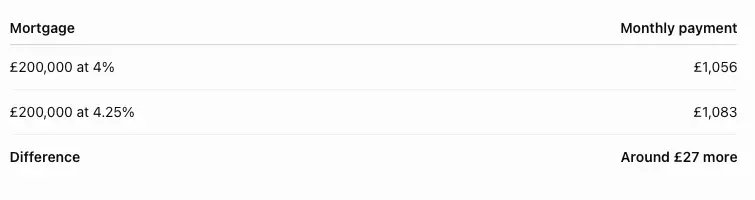
That’s approximately £324 a year.
This is an illustration rather than a prediction of what any particular lender will charge.
It assumes the entire mortgage rate increases by 0.25 percentage points, with the outstanding balance and remaining term unchanged.
Your actual payments will depend on your mortgage arrangements.
What does the rate rise mean if you’re buying a home?
If you’re currently looking for a property, yesterday’s decision doesn’t necessarily mean you need to change your plans.
But it is a good reason to check your figures.
Mortgage affordability depends on several factors, including your income, outgoings, deposit, credit history and the lender’s assessment.
A change in borrowing costs can affect the amount you’re comfortable spending.
However, if you’ve already secured a mortgage offer, the interest rate may be protected for a specified period.
Your lender or broker can confirm what applies.
Three things buyers should check
First, confirm your mortgage position.
If you have an agreement in principle, ask whether the lender’s current affordability assessment or available rates have changed.
If you have a formal offer, check its terms and expiry date.
Second, calculate the monthly cost of your move.
Don’t focus solely on the purchase price.
Consider mortgage repayments, council tax, utilities, insurance and the other costs of owning the property.
Third, keep an eye on the wider market.
When some buyers become more cautious, there may be opportunities to negotiate.
That doesn’t mean every seller will accept a lower offer.
But understanding how long a property has been marketed, its asking-price history and comparable sales can help you make an informed decision.
What does the 2026 Budget mean for first-time buyers?
The Autumn Budget on 28 October included measures relevant to people saving for their first home.
One change concerns the Lifetime ISA.
For qualifying first-home purchases above the existing £450,000 property price cap, the withdrawal charge has been reduced from 25% to 20% for withdrawals made from 29 October 2026.
The change is designed to allow affected buyers to retain their own contributions while losing the government bonus, rather than also losing part of their original savings.
However, a 20% charge still applies in those circumstances, and the normal Lifetime ISA eligibility rules remain important.
The Budget also announced plans for a new First Time Buyer ISA and a scheme called Your First Home.
Under the announced proposals, Your First Home would provide qualifying buyers of eligible new-build homes in England with access to an equity loan of up to 20% and a minimum deposit of 2.5%.
The scheme is expected to open in stages during 2027.
Because further guidance and eligibility details are still being developed, buyers shouldn’t base a purchase on an assumption that they’ll qualify.
A mortgage adviser can help explain the options currently available.
What does the rate rise mean if you’re selling your home?
For sellers, the main consideration is buyer affordability.
When borrowing costs increase, some buyers may reassess their budgets.
Others may decide to delay moving.
But plenty of people will still need or want to move because of work, family circumstances or changing housing needs.
The key is understanding what buyers are willing and able to pay.
Getting the asking price right matters
In a market where buyers are comparing properties carefully, an unrealistic asking price can make attracting interest more difficult.
A property might be well presented and in a desirable location, but buyers still need to see value compared with the alternatives.
At Location Location East, we believe the initial marketing period is particularly important.
The first two to three weeks can tell us a great deal about buyer interest, with a more detailed review around weeks three to four if the response isn’t what we’d expected.
That doesn’t mean every property should sell immediately.
But it does mean we shouldn’t ignore what the market is telling us.
Think about your onward purchase too
If you’re selling one home to buy another, don’t assess the transaction in isolation.
A change in market conditions may affect the property you’re buying as well as the one you’re selling.
For somebody moving to a larger home, the difference between the two prices can be particularly important.
And if you’ve already agreed a sale or purchase, speak to your mortgage adviser before making assumptions about affordability.
Will the rate rise affect property prices in Thetford and Breckland?
Interest rates influence the housing market, but they aren’t the only factor.
Local employment, housing supply, property types, buyer demand and affordability all matter.
A two-bedroom home aimed at first-time buyers in Thetford may respond differently from a larger detached property in Mundford or a bungalow in Brandon.
Some buyers may be more sensitive to mortgage costs than others.
And the availability of competing homes can influence how quickly a property sells.
It’s therefore difficult to predict what a single Bank Rate decision will mean for an individual property’s value.
A proper local appraisal should consider recent comparable sales, current competition and the property’s particular features.
National headlines provide context.
They don’t replace local evidence.
What does the rate rise mean for landlords?
For landlords with buy-to-let mortgages, the impact depends on the mortgage product.
A fixed-rate deal will generally remain unchanged until the agreed period ends.
Tracker and variable-rate products may become more expensive.
Landlords approaching the end of a fixed-rate period should review their borrowing arrangements and speak to a qualified adviser.
Buy-to-let affordability assessments may also consider rental income, interest coverage requirements and other lending criteria.
The October Budget announced further changes affecting taxation of property income from April 2027.
Landlords should discuss the implications with their accountant, particularly if they’re reviewing the longer-term financial viability of an investment.
For those considering selling a rental property, Location Location East can provide residential sales advice and a market appraisal.
What if you’re renting?
A rise in Bank Rate doesn’t automatically increase your rent.
A landlord’s mortgage costs and the rent payable under a tenancy are separate matters.
In England, the Renters’ Rights Act reforms introduced new rules governing rent increases for most private assured periodic tenancies from May 2026.
These generally limit increases to once a year, require at least two months’ notice using the prescribed procedure, and allow tenants to challenge proposed rents through the First-tier Tribunal where appropriate.
The exact legal position depends on the tenancy and circumstances.
Landlords and tenants should consult current government guidance if they’re unsure.
Will the Bank of England raise interest rates again?
Nobody can say with certainty.
The next scheduled Bank Rate decision is on 17 December 2026.
The Bank has made clear that future decisions will depend on economic evidence, particularly inflation, energy costs and the extent to which higher prices affect the wider economy.
Some policymakers have indicated that further increases could be necessary if inflation pressures persist.
Others have emphasised the uncertainty surrounding the outlook.
So it’s sensible to be cautious about predictions.
The most useful thing you can do is understand your own finances and prepare for different possibilities.
What should homeowners do now?
You don’t need to make a major financial decision simply because Bank Rate has changed.
But there are a few useful things worth checking.
If you have a mortgage, find out when your current deal ends.
If you’re approaching renewal, speak to a mortgage adviser about the options available.
If you’re buying, confirm that your borrowing arrangements remain suitable.
And if you’re selling, make sure your asking-price strategy reflects the current market rather than relying on what similar properties might have achieved a year ago.
Moving home in Thetford, Norfolk or Suffolk?
At Location Location East, we’re an independent estate agency based in Thetford, helping people buy and sell homes across the Brecks and wider Norfolk and Suffolk.
We understand that mortgage rates, household costs and economic headlines can make moving decisions feel more complicated.
Our role is to help you understand the property side of that decision.
That means providing realistic appraisals, explaining local market conditions and helping you assess your options.
We don’t provide regulated mortgage advice, but we can work alongside your chosen mortgage adviser and conveyancer as your plans progress.
And if the figures suggest that waiting is the better option, that’s a perfectly reasonable conclusion too.
Don’t let one interest rate announcement make the decision for you
Yesterday’s increase to 4% matters.
But it won’t affect every homeowner in the same way.
Some borrowers will see no immediate change.
Others will face higher repayments.
And buyers and sellers may need to review their plans in light of current borrowing costs.
The important thing is to understand what the decision means for your own circumstances.
Know your mortgage position, check your figures and make decisions based on what you can realistically afford, rather than the headline alone.
Frequently Asked Questions
What is the Bank of England interest rate in November 2026?
Bank Rate is 4% following the Monetary Policy Committee’s decision announced on 5 November 2026. It increased from 3.75%.
Will my fixed-rate mortgage increase after the Bank Rate rise?
No, not during the agreed fixed-rate period. Your contractual mortgage rate remains unchanged until the fixed deal ends, unless other specific mortgage terms apply.
How much will my tracker mortgage increase?
A tracker linked directly to Bank Rate will generally increase by 0.25 percentage points, subject to the mortgage terms. The change in monthly payments depends on your balance and repayment arrangements.
Will standard variable mortgage rates increase?
They may. Lenders decide whether and how much to adjust their standard variable rates, subject to their mortgage terms.
Should I remortgage now that interest rates have risen?
That depends on your current mortgage, when your deal ends, available products and any early repayment charges. A qualified mortgage adviser can help you assess the options.
Will the Bank Rate rise affect house prices in Thetford?
It may influence buyer affordability and demand, but property values also depend on local supply, location, condition and the type of home. One interest rate decision doesn’t determine an individual property’s value.
Is it still a good time to buy a house in Breckland?
That depends on your finances, the property and your longer-term plans. A mortgage adviser can confirm affordability, while local property market evidence can help you assess the asking price.
What changed for first-time buyers in the October 2026 Budget?
The Lifetime ISA withdrawal charge for qualifying first-home purchases above £450,000 was reduced to 20% from 29 October 2026. The government also announced plans for further first-time buyer support schemes.
Can my landlord increase my rent because interest rates have gone up?
A higher Bank Rate does not automatically change your rent or override tenancy legislation. Rent increases must comply with the applicable legal rules and tenancy arrangements.
When is the next Bank of England interest rate decision?
The next scheduled Monetary Policy Committee decision is Thursday 17 December 2026.
Sources and further reading
- Bank of England: November 2026 Monetary Policy Summary and Minutes
- Bank of England: Latest Bank Rate decision
- GOV.UK: Lifetime ISA withdrawals for a first home
- GOV.UK: Lifetime ISA withdrawal charge changes
Information reflects the position on 6 November 2026. This article provides general property-market information, not personalised mortgage, financial, tax or legal advice. Government schemes and mortgage products are subject to eligibility and change.
Article by Andrew Overman | Partner | Location Location East