
The latest property market figures have arrived, and the headlines aren’t particularly encouraging for homeowners.
Rightmove’s November 2026 House Price Index reports that the average asking price of a newly listed home in Great Britain has fallen by 1.8% in a month.
That’s a reduction of £6,745, bringing the national average asking price to £364,270.
But before anybody starts worrying about what their own property might be worth, there’s something important to understand.
A fall in asking prices doesn’t necessarily mean every home has lost value.
And it certainly doesn’t mean the property market has stopped moving.
What we’re seeing is a market where buyers have more choice, mortgage affordability remains challenging and sellers are having to think more carefully about how they position their homes.
For people considering buying or selling in Thetford, Brandon and across Breckland, understanding what’s behind these figures is far more useful than reacting to the headline alone.
What does Rightmove’s November 2026 report actually tell us?
The latest report, published on 16 November, highlights several important developments.
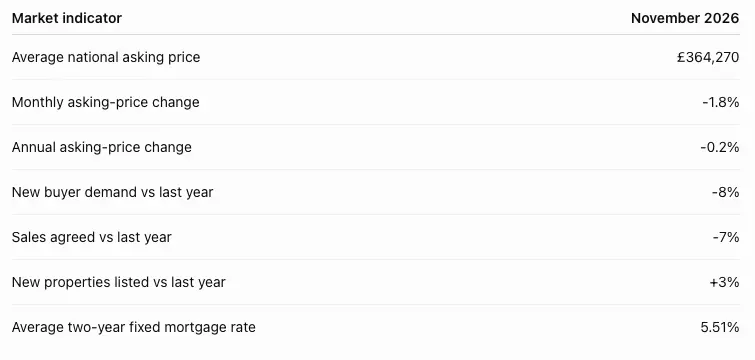
The figures tell us that sellers are adjusting their expectations, buyers are being more selective and borrowing costs continue to influence affordability.
But there’s another important detail.
November normally sees asking prices soften as Christmas approaches.
Over the past ten years, the average November fall has been approximately 1.1%.
This year’s 1.8% decline is therefore larger than the usual seasonal adjustment.
That suggests sellers are responding to more than just the time of year.
Are house prices actually falling, or are sellers simply asking for less?
This distinction matters.
Rightmove’s House Price Index measures the asking prices of properties coming onto the market.
It doesn’t measure the prices buyers eventually pay when transactions complete.
For example, imagine a property that might previously have been advertised at £300,000.
A seller entering today’s market might decide to launch at £290,000 to attract more interest.
That would contribute to a lower average asking price.
But it doesn’t tell us whether comparable homes have actually been selling for £300,000, £290,000 or another figure.
Completed sales data provides a different perspective, although it becomes available later because property transactions take time.
Both measures are useful.
Rightmove helps us understand how sellers are positioning their properties today.
Completed sales help us understand what buyers have actually been prepared to pay.
A reliable property appraisal should consider both, alongside the homes currently competing for buyers.
What’s happening in the East of England?
The regional figures are particularly relevant to homeowners across Norfolk and Suffolk.
According to Rightmove’s November report, the East of England recorded:
The region has experienced a smaller monthly reduction than the national average, but asking prices are 1.1% below the same period last year.
That suggests a market where pricing remains under pressure.
However, the East of England covers a substantial area, including markets with very different property values.
Cambridge, coastal Suffolk, commuter towns and rural Norfolk don’t all behave in the same way.
And the regional average asking price of £409,840 certainly shouldn’t be treated as the average value of a home in Thetford.
Thetford and the surrounding Breckland villages have their own property mix, buyer demand and price expectations.
That’s why understanding the local market is essential.
What does this mean for the Thetford and Breckland property market?
The national and regional figures provide context, but the impact on individual homes will depend on their location, type, condition and asking price.
Consider the difference between a two-bedroom terraced home in Thetford and a four-bedroom detached property in Mundford.
They’re likely to attract different buyers, with different budgets and motivations.
A bungalow in Brandon may appeal to downsizers who have already sold their previous property.
A larger family home might attract buyers who need to sell before they can proceed.
And a first-time buyer purchasing a smaller property may be particularly sensitive to mortgage repayments.
The important question isn’t simply whether house prices are rising or falling.
It’s whether the right buyers are active for the type of property you’re selling.
And whether your home represents good value compared with the alternatives available to them.
Why are mortgage rates having such an impact?
Mortgage affordability remains one of the biggest influences on the market.
Rightmove reports that the average two-year fixed mortgage rate is currently 5.51%.
That’s slightly lower than October’s 5.55%, but considerably higher than the 4.25% recorded earlier in the year.
According to Rightmove, the increase since February has added just over £200 a month to the cost of a typical new mortgage.
For many households, that’s a meaningful difference.
A buyer who was comfortable borrowing a certain amount earlier in the year may now need to reconsider their budget.
They might choose a smaller property.
Look at a different location.
Increase their deposit.
Or wait until their finances allow them to move comfortably.
This doesn’t mean buyers have disappeared.
It means affordability is influencing their decisions more heavily.
And sellers need to recognise that.
Buyers have more choice than they’ve had for years
One of the most significant findings in the report is the number of homes available.
Rightmove says the number of properties for sale across Great Britain is at its highest level for 12 years.
At the same time, new listings are 3% higher than a year ago.
Buyer demand is down 8%, while the number of sales agreed is down 7%.
In other words, there’s more property available, but slightly less buying activity than this time last year.
That changes the balance between buyers and sellers.
When several similar properties are available, buyers can afford to compare them carefully.
They can consider the condition, location, asking price and likely costs of moving in.
And if one property doesn’t appear to offer good value, they may have other options.
For sellers, this means standing out matters.
Not necessarily by having the most expensive kitchen or the biggest garden.
But by making sure the property is presented well, marketed effectively and priced appropriately for its intended buyers.
Why the first asking price matters more than ever
There’s a particularly revealing statistic in Rightmove’s research.
Properties that find a buyer without needing an asking-price reduction take an average of 39 days to secure a sale.
Those requiring a reduction take an average of 119 days.
That’s an 80-day difference.
Rightmove also reports that properties not requiring a reduction are 13% more likely to sell.
These figures don’t prove that a reduction itself causes a property to take longer to sell.
Properties requiring reductions may have been overpriced initially or faced other difficulties.
But they reinforce the importance of getting the initial strategy right.
When your home first appears on the market, it has an opportunity to attract buyers who have been actively searching.
They may receive property alerts, see it among the newest listings or be introduced to it by the estate agent.
If the asking price is significantly above what buyers consider reasonable, that initial attention may not translate into viewings.
And while a later reduction can generate fresh interest, it doesn’t automatically recreate the opportunity of a well-planned launch.
Does that mean sellers should price their homes cheaply?
No.
There’s a difference between pricing competitively and undervaluing a property.
The aim should always be to achieve the strongest realistic selling price.
But that figure needs to be supported by evidence.
A good estate agent should explain the comparable sales, current competition and likely buyer demand behind their recommendation.
The highest suggested asking price isn’t necessarily the valuation most likely to produce the best result.
What if your property is already on the market?
If your home has been advertised for several weeks without meaningful interest, it’s worth reviewing the evidence.
Start with the enquiries and viewings.
Are buyers seeing the property online?
Are they requesting viewings?
What feedback are they giving?
Have similar homes been selling while yours remains available?
And has the competition changed since you launched?
A property attracting plenty of viewings but no offers may need a different response from one receiving very few enquiries.
Sometimes the asking price needs reconsidering.
Sometimes the photography, description or presentation isn’t doing the property justice.
And sometimes a change in marketing strategy is required.
The important thing is not to let weeks pass without understanding what’s happening.
At Location Location East, we regard the early marketing period as particularly valuable for assessing buyer response.
We believe sellers deserve clear feedback and informed recommendations rather than simply being told to wait.
Is this a good time to buy a property?
For some buyers, the current market could offer opportunities.
More available properties means more choice.
And sellers who are motivated to move may be willing to consider realistic offers.
However, that doesn’t mean every property is negotiable or that buyers should automatically expect a substantial discount.
A well-priced home in a desirable location can still attract strong interest.
The key is understanding what represents value.
If you’re buying in Thetford or the surrounding area, consider:
- How the asking price compares with similar properties.
- Whether the property has been reduced previously.
- How long it has been on the market.
- The condition of the home and any likely repair costs.
- Whether the seller has found an onward property.
- Your mortgage affordability and total moving costs.
It’s also worth remembering that the lowest purchase price doesn’t necessarily represent the best overall value.
A property requiring substantial work may cost more in the long run than one that’s ready to move into.
What if you’re selling and buying at the same time?
This is where a slower market can become particularly interesting.
If you’re moving to a more expensive property, it’s worth looking at the difference between your selling price and your purchase price.
That’s sometimes called the trading gap.
Imagine you’re selling a home for £250,000 and buying one for £400,000.
The difference is £150,000.
Now imagine your home sells for £245,000, but you negotiate the purchase of your next property down to £380,000.
Your trading gap becomes £135,000.
Despite selling your existing home for £5,000 less, the difference between the two transactions has reduced by £15,000.
These are hypothetical figures, not recorded local price changes.
And mortgage costs, stamp duty and other expenses still matter.
But they demonstrate why homeowners shouldn’t assess their move solely by what their current property is worth.
If you’re buying something more expensive, the price of the home you’re moving to matters just as much.
Are flats and houses performing differently?
Rightmove’s report also highlights differences between property types.
Across Great Britain, average asking prices for flats are 1.7% lower than a year ago.
Houses, meanwhile, have seen a modest annual increase of 0.1%.
Over the past decade, Rightmove reports asking-price growth of approximately 5% for flats compared with 30% for houses.
Flats are also taking longer to find buyers nationally, averaging 79 days compared with 68 days for houses.
These figures reflect the national market and shouldn’t be applied directly to every flat or house in Breckland.
But they demonstrate an important principle.
There isn’t one single property market.
Different property types can perform very differently, even within the same town.
That’s why a valuation based only on an area’s average price can be misleading.
Should you wait until spring 2027 to sell?
It’s a reasonable question.
Spring is traditionally a busy period for the housing market, and some homeowners prefer to wait until after Christmas.
But waiting isn’t automatically the best decision.
There may be fewer buyers searching during December, but there can also be fewer competing properties.
Some people still need to move because of work, family circumstances or a change in their living arrangements.
And buyers planning a move in the new year may already be researching their options.
The right decision depends on your circumstances and the property itself.
If your home is ready and your plans are clear, there may be no reason to delay purely because of the calendar.
Alternatively, you might use the coming weeks to prepare the property, arrange an appraisal and develop a launch strategy for the new year.
At Location Location East, we can also discuss pre-launch marketing where appropriate, helping sellers explore early buyer interest before a wider public launch.
What should sellers take from November’s market figures?
Three things stand out.
Buyers are still moving
Although sales agreed are 7% below last year, transactions are continuing.
This isn’t a market where everybody has stopped buying.
Pricing needs to reflect today’s conditions
Higher borrowing costs and greater choice mean buyers are comparing properties carefully.
A valuation needs to reflect current demand, not simply what a similar home was advertised for several months ago.
The quality of the estate agency service matters
When buyers are selective, how a property is marketed, how enquiries are handled and how viewings are followed up become particularly important.
So does the ability to negotiate and keep a sale progressing once an offer has been accepted.
Achieving an agreed sale is only part of the process.
Getting it through to completion matters too.
What does this mean for buyers and sellers across Norfolk and Suffolk?
The November figures suggest a market that remains active but requires more careful decision-making.
For sellers, realistic expectations and a considered marketing strategy are important.
For buyers, greater choice may create opportunities, provided the purchase remains affordable.
And for people moving from one property to another, it’s worth considering the complete transaction rather than focusing on one asking price.
At Location Location East, we’re an independent estate agency based in Thetford, working with homeowners across the Brecks and wider Norfolk and Suffolk.
Our approach is built around understanding the local market, identifying the right buyers and providing clear advice throughout the selling process.
We believe homeowners should understand not just what their property might be worth, but why.
And when market conditions change, that advice should change with them.
The market hasn’t stopped. It’s become more selective.
It’s easy to look at falling asking prices and assume the worst.
But Rightmove’s November report tells a more balanced story.
Buyers have more choice.
Mortgage affordability remains challenging.
Sellers are adjusting their expectations.
And homes are still finding buyers.
For anyone thinking about moving, the most useful response isn’t to panic or try to predict exactly what happens next.
It’s to understand the market you’re moving in.
Because the right price, the right property and the right strategy matter far more than any single national headline.
Frequently Asked Questions
Are house prices falling in Thetford in November 2026?
Rightmove reports that average asking prices across the East of England fell by 1.3% in November and were 1.1% below a year earlier. These are regional asking-price figures, not a direct measurement of completed property sales in Thetford.
What is the average house price in Breckland?
There are different measures of house prices, including asking prices and completed sales. Rightmove’s East of England asking-price average of £409,840 should not be treated as Breckland’s average property value. A local appraisal provides a more relevant assessment of an individual home.
Is November 2026 a bad time to sell a house?
Not necessarily. Buyers remain active, although mortgage affordability and greater choice are affecting decisions. The right timing depends on the property, local competition and your circumstances.
Why are asking prices falling in the UK?
Rightmove attributes the larger-than-usual November reduction to higher mortgage costs, pressure on buyers’ budgets and sellers adjusting their expectations. Seasonal factors also contribute.
Are buyers still purchasing homes in Thetford and Breckland?
Yes, property transactions continue, although national activity is lower than a year ago. Demand varies by property type, price and location, so national figures cannot establish the level of interest in a particular home.
How long does it take to sell a house in the East of England?
Rightmove’s November 2026 regional data indicates an average of 73 days to find a buyer. This isn’t the same as the time required to exchange contracts or complete a sale, and individual properties can sell faster or slower.
Should I reduce my asking price if my house isn’t selling?
Possibly, but first review viewing activity, buyer feedback, marketing quality and competing properties. Any adjustment should be supported by evidence rather than made automatically.
Is it a buyer’s market in Norfolk and Suffolk?
Greater choice nationally gives buyers more negotiating power, but conditions vary between local areas and property types. Well-priced, desirable homes can still attract competition.
Should I wait until spring 2027 to put my home on the market?
That depends on your circumstances and the likely demand for your property. Waiting may provide time to prepare, but it doesn’t guarantee a higher selling price or better market conditions.
Can Location Location East help me understand my property’s value?
Yes. Location Location East provides property appraisals and residential sales advice across Thetford, the Brecks and wider Norfolk and Suffolk, using local market evidence and comparable properties to inform its recommendations.
Source: Rightmove House Price Index, 16 November 2026.
Read the full Rightmove House Price Index
Rightmove’s figures measure asking prices of newly listed properties, not completed selling prices. National and regional statistics should not be interpreted as valuations of individual properties. Mortgage rates and market conditions may change.
Article by Andrew Overman | Partner | Location Location East