
Nobody particularly enjoys hearing that house prices are falling.
Especially when they own one.
After years of paying the mortgage, maintaining the property and perhaps making improvements, it’s understandable to want your home to be worth as much as possible.
But here’s something that often gets overlooked.
If you’re selling one property to buy a more expensive one, a slower housing market could actually work in your favour.
Not because losing value on your existing home is good news.
But because the property you want to buy may also have become more affordable.
And if you’re moving up the property ladder, that difference can matter more than the individual prices.
It’s something called the trading gap.
For homeowners considering upsizing in Thetford, Brandon or elsewhere across Breckland, understanding it could change how you look at your next move.
What is the trading gap when moving house?
The trading gap is simply the difference between the price you sell your current home for and the price you pay for your next one.
Imagine you own a three-bedroom house worth £250,000.
You’ve been looking at larger four-bedroom detached properties around £400,000.
The difference is £150,000.
That’s your trading gap.
It doesn’t mean you necessarily need an additional £150,000 mortgage. Your existing mortgage balance, equity, savings and other financial arrangements will determine how you fund the move.
But it gives you a useful starting point for understanding the relative cost of moving up the property ladder.
And here’s where things become interesting.
How can falling house prices make upsizing cheaper?
Let’s use an example based on property prices that are more relevant to our local market.
Imagine you’re selling a home valued at £250,000 and buying one at £400,000.
Now suppose both properties fall in value by 5%.
Before and after a hypothetical 5% fall
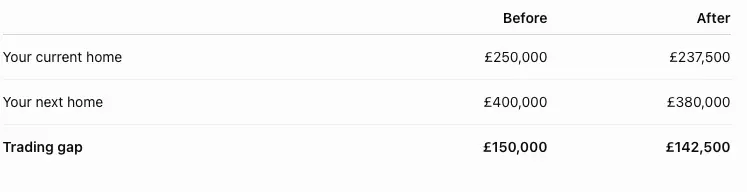
£7,500 smaller trading gap
Even though your current home has fallen in value by £12,500, the property you’re buying has fallen by £20,000.
The difference between the two prices has narrowed by £7,500.
That’s the important part.
You haven’t gained £7,500 in cash.
But the amount separating your current property from your next one has reduced.
And depending on your mortgage, savings and other circumstances, that could make the move more affordable.
These are illustrative figures, not actual price movements in Thetford or Breckland.
What if larger homes fall further in value?
The potential benefit becomes greater if the property you’re buying experiences a larger reduction than the one you’re selling.
This can happen in certain market conditions.
Higher-value homes may face a smaller pool of buyers.
Larger mortgages can make purchasers more sensitive to borrowing costs.
And some buyers looking for bigger homes have the flexibility to delay their move.
But it isn’t a universal rule. Different property types and locations can behave very differently.
Let’s consider another hypothetical example.
You’re selling a property originally worth £250,000, which has fallen by 2%.
The larger home you want was originally £400,000 but has fallen by 5%.
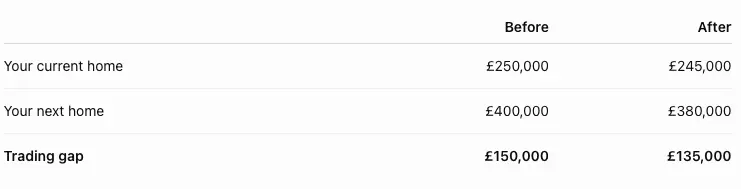
£15,000 smaller trading gap
In this scenario, the trading gap has reduced by £15,000.
That’s a meaningful difference.
But the figures only become relevant to your own move when they’re based on what your property could realistically sell for and what the seller of your next home might accept.
What’s happening to house prices in Breckland?
The local picture is important.
According to the Office for National Statistics, the average house price in Breckland was approximately £267,000 in August 2026.
That was broadly unchanged from the previous year.
So it wouldn’t be accurate to describe the entire Breckland property market as falling sharply.
However, the wider market has become more challenging for some sellers.
Zoopla’s October 2026 House Price Index reported that buyers nationally had 7% more homes to choose from than a year earlier.
It also found that house prices were falling in a growing number of southern England markets, while other regions continued to experience modest growth.
The East of England has seen relatively subdued price performance.
But regional averages don’t tell us what is happening in every local price bracket.
A smaller terraced property in Thetford may experience different demand from a substantial detached house in a surrounding village.
And that’s precisely why the trading gap needs to be calculated using the two types of property involved in your move.
Why might a slower market suit families looking for more space?
Imagine you’ve been living in a three-bedroom house for several years.
Perhaps the children are getting older.
Working from home has become part of everyday life.
Or you’d simply like a larger garden, another bedroom or a separate office.
You know what you’d like to buy.
But the cost of making that move has always felt a little too high.
In a market where prices are rising quickly, the property you’re hoping to buy may become more expensive faster than your current home.
That can make the gap harder to bridge.
In a slower market, that pressure may ease.
You may find more properties available.
You may have more time to compare them.
And sellers who have been on the market for a while may be more open to discussing realistic offers.
None of that guarantees a bargain.
But it can create opportunities that weren’t available when buyers were competing heavily for the same homes.
Does the trading gap work if you’re moving from Thetford to a nearby village?
Yes, the principle still applies.
For example, you might be selling a modern family house in Thetford and hoping to buy a larger detached property in Mundford, Euston or one of the surrounding villages.
Or perhaps you’re moving from Brandon to a property with more land or additional accommodation.
The key is to compare the actual market conditions for both properties.
If your existing home is in a price bracket with strong buyer demand, while the larger homes you’re considering have fewer active purchasers, the relative difference may be favourable.
But it could work the other way.
If your existing property is proving difficult to sell and your target home is particularly sought-after, the trading gap could widen.
That’s why local evidence is essential.
Why the price you achieve on your own home still matters
There’s a danger in taking the trading-gap argument too far.
It doesn’t mean you should accept a poor offer on your current property simply because you’re buying something more expensive.
You still want to achieve the strongest realistic selling price.
And you still need to consider whether the onward purchase represents good value.
The advantage comes from understanding both transactions together.
For example, imagine you’ve accepted an offer £5,000 below your original expectations.
That’s disappointing.
But if you’ve negotiated £15,000 off the property you’re buying, your overall position may still be better than you’d anticipated.
Looking at only the sale price would miss that.
Equally, negotiating a large discount on your next home doesn’t help much if you’ve accepted an unnecessarily low price for your own.
Both sides matter.
What about the cost of borrowing?
This is where the calculations need to go beyond property prices.
A smaller trading gap doesn’t automatically mean lower monthly mortgage payments.
If mortgage interest rates have increased, the additional borrowing could still be more expensive than expected.
Your mortgage balance, available equity, deposit, loan term and lender’s affordability assessment all affect the outcome.
You’ll also need to consider:
- Stamp Duty Land Tax.
- Estate agency fees.
- Solicitors’ and conveyancing costs.
- Survey and mortgage-related costs.
- Removals.
- Any immediate repairs or improvements.
- The ongoing costs of running a larger home.
For an owner-occupier replacing their main residence in England, standard Stamp Duty Land Tax rates will generally apply where the relevant conditions are met. Different rules can apply if you own additional properties or complete your purchase before selling your previous main residence.
A mortgage adviser and conveyancer can help you understand the full financial picture.
A £10,000 saving on the trading gap is useful, but only if the overall move remains affordable.
Should you sell your existing home before finding the next one?
This is one of the biggest decisions facing upsizers.
Many people are understandably reluctant to put their home on the market before they’ve found somewhere they love.
They worry about selling too quickly and having nowhere to go.
But there’s another side to consider.
If you find your ideal property before you’ve secured a buyer, you may not be in a position to proceed.
And the seller may prefer an offer from somebody whose own home is already sold subject to contract.
Getting your property ready for sale, understanding its realistic value and speaking to a mortgage adviser can put you in a stronger position.
At Location Location East, we can also discuss whether a pre-launch approach might be appropriate.
That may allow us to introduce your home to suitable registered buyers while you’re preparing for your onward move.
The right sequence depends on your circumstances, but being prepared gives you more options.
What if you’re worried about selling for less than your home was worth last year?
That’s understandable.
Property ownership is personal.
And it’s difficult to separate the financial value of a home from the years you’ve spent living in it.
But when you’re moving, historical values don’t necessarily tell you whether today’s transaction makes sense.
What matters is what you can realistically achieve now, what your next property will cost and whether the overall move works for you.
Imagine your home was worth £260,000 last year but is now worth £250,000.
It’s natural to focus on the £10,000 difference.
But if the larger home you wanted has fallen from £420,000 to £395,000, the trading gap has actually reduced from £160,000 to £145,000.
You’re looking at a £15,000 smaller difference between the properties.
That doesn’t erase the disappointment of a lower sale price.
But it does provide a more complete picture.
Could waiting make the move more expensive?
Possibly.
But it could also make it cheaper.
Nobody can reliably predict the precise direction of local property prices or mortgage rates.
If prices rise, the trading gap may widen again.
If larger homes become less expensive relative to smaller properties, it may narrow further.
Mortgage rates could also change the affordability calculation.
That’s why making a decision purely on a forecast can be risky.
Instead, consider what is available now.
What could you sell your home for?
What could you realistically buy?
How much additional borrowing would you need?
And would the move improve your quality of life enough to justify the cost?
Those are questions you can answer with much greater confidence than trying to predict the market twelve months from now.
How can Location Location East help you understand your trading gap?
At Location Location East, we work with homeowners across Thetford, the Brecks and wider Norfolk and Suffolk.
If you’re thinking about upsizing, we can help you understand both sides of the move.
That begins with an evidence-based appraisal of your existing home.
We can then discuss the type of property you’re looking for, the likely price range and the competition in that part of the market.
The aim is to give you a realistic picture of the difference between selling and buying.
Not simply a valuation figure that sounds encouraging.
And not an assumption that every property is moving in the same direction.
Sometimes the figures suggest it’s a sensible time to move.
Sometimes they suggest waiting or reconsidering the budget.
Either way, having the information puts you in a better position to decide.
Don’t just look at what your home is worth. Look at what your next home will cost.
When people talk about a slower housing market, the conversation usually focuses on what homeowners might have lost.
But if you’re planning to move to a more expensive property, there’s another side to the equation.
The home you want may also be available for less.
And because it’s worth more than the property you’re selling, even a similar percentage reduction can make a bigger difference in pounds.
That’s the trading gap.
It won’t make every move affordable.
And it doesn’t mean that a slower market is automatically good news.
But it does mean that a lower selling price isn’t necessarily a reason to put your plans on hold.
Sometimes the opportunity is in the difference between the two prices, rather than either price on its own.
Frequently Asked Questions
What is the trading gap when moving house?
The trading gap is the difference between the price you sell your existing home for and the price you pay for your next property. It helps illustrate the additional cost of moving up or down the property ladder.
Is a falling property market good for upsizers?
It can be. If the more expensive property you’re buying falls further in cash terms than the home you’re selling, the trading gap becomes smaller. However, mortgage costs and other moving expenses still need to be considered.
Are house prices falling in Thetford and Breckland?
ONS figures for August 2026 showed average house prices in Breckland broadly unchanged from a year earlier. Individual property types and locations may perform differently, so local comparable sales are important.
Why can bigger houses become relatively cheaper in a slower market?
Higher-value properties may have a smaller buyer pool and can be more sensitive to mortgage affordability. However, larger homes don’t always fall faster in percentage terms, and local supply and demand are important.
Should I sell my house before looking for a bigger property?
Being sold subject to contract can strengthen your position as a buyer, but the right approach depends on your circumstances, finances and available properties.
Can I upsize if my current home has fallen in value?
Potentially. What matters is your available equity, mortgage affordability, the price of your next home and the overall cost of moving.
Does a smaller trading gap mean lower mortgage repayments?
Not necessarily. Mortgage interest rates, borrowing amounts, repayment terms and your existing equity will determine the monthly cost.
Is now a good time to buy a four-bedroom house in Thetford?
That depends on the properties available, your budget and the level of demand in that price bracket. Comparing realistic selling and buying prices can help establish whether the move is financially attractive.
Does the trading-gap principle apply when moving from Thetford to Brandon or Mundford?
Yes. It applies whenever you’re selling one property and buying another. The important consideration is how prices are behaving in the two relevant local markets.
Can Location Location East help me work out whether upsizing is affordable?
We can provide a property appraisal and discuss local selling and buying prices. A qualified mortgage adviser can then help assess the borrowing and repayment implications.
Sources and further reading
- ONS: Housing prices in Breckland.
- Zoopla House Price Index, October 2026.
- Location Location London: The Trading Gap.
- Location Location East: Property valuation.
The worked examples are illustrative and do not represent actual valuations or recorded price changes for particular properties. Mortgage and tax circumstances vary.
Article by Andrew Overman | Partner | Location Location East